
Chess remains an undisputed classic, enjoying a modern surge in popularity despite being notoriously difficult to reinvent. Steam is currently crowded with indie developers attempting to crack this code – ranging from the mind-bending 5D Chess With Multiverse Time Travel to clever puzzles like Chessformer and Chessarama. We have even seen successful genre blends like the roguelites Pawnbarian and Shotgun King: The Final Checkmate, making it increasingly difficult for any newcomer to truly stand out in such a competitive field.
The latest entry to join this fray is Gambonanza, an indie title that attempts to inject the high-stakes gambling energy of Balatro into a chess-based roguelike formula. Unfortunately, the game stumbles over its own feet far too often. It makes so many fundamental errors in its execution that it becomes difficult to recommend, even to the most casual chess enthusiast looking for a quick distraction.
Reviewing a title like this presents a unique challenge because, as a competitive chess player, my perspective is naturally colored by a deep understanding of the game’s mechanics. However, even when viewed through the lens of a casual player seeking simple entertainment, Gambonanza falters. As a roguelite, it suffers from significant flaws regarding its difficulty curve, pacing, and the lack of meaningful variety in the choices presented to the player.
The core gameplay loop is structured around a series of isolated combat encounters on a traditional board – divided into five stages with five levels each, culminating in a boss fight. For the most part, these battles follow the standard rules of the “royal game.” You and an AI opponent take turns moving pieces that behave exactly as they would in a standard match, at least until the game’s various modifiers begin to warp the experience.
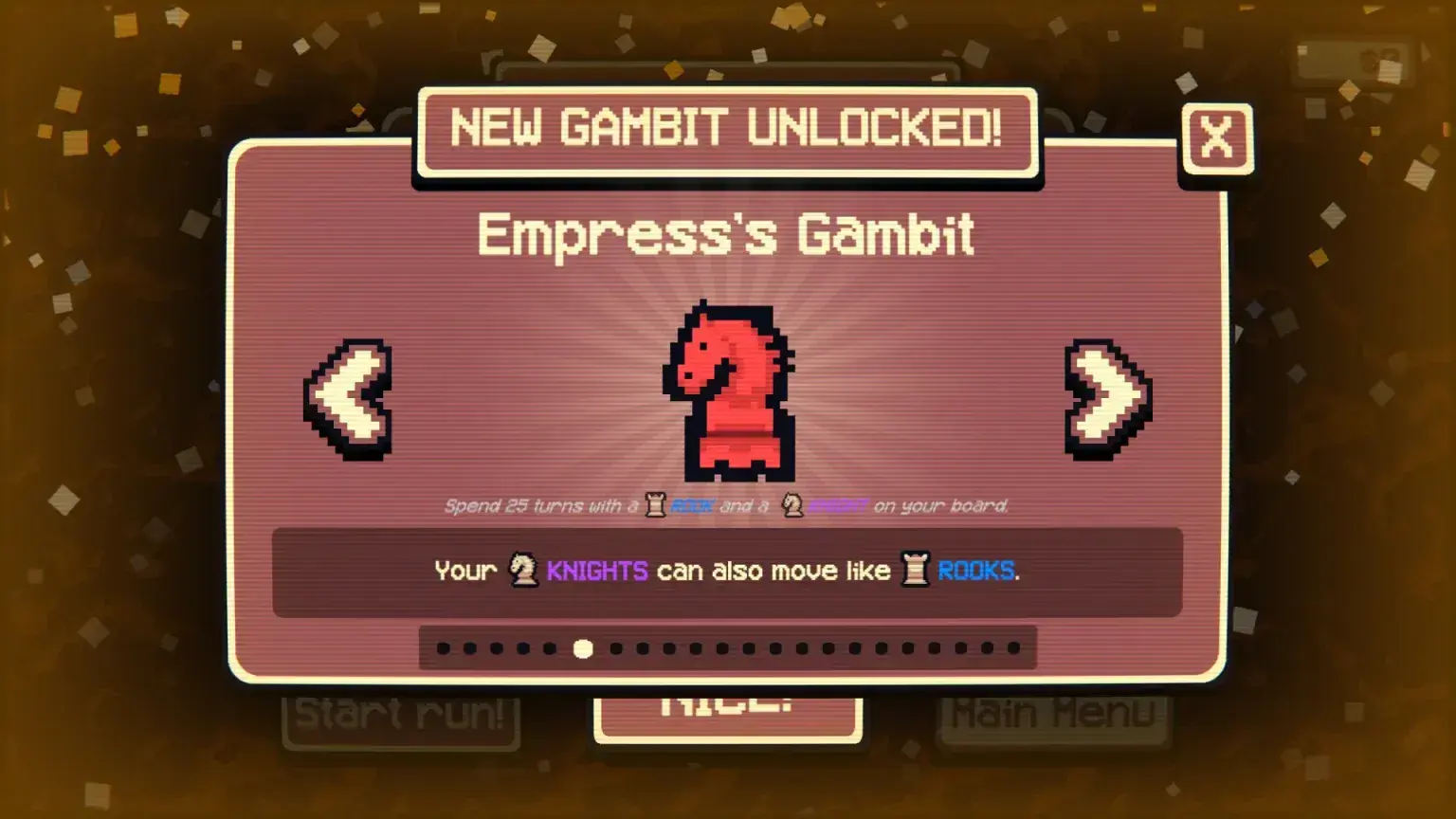
Strategy begins before the first move is made; at the start of a stage, you can see the opponent’s lineup and manually position your own pieces on your side of the board. The traditional experience is further altered by “Gambits” – global aura effects that provide statistical or mechanical bonuses. These range from a chance to force the opponent to skip a turn if you hold specific pieces to allowing your bishops to move like queens. Sadly, these modifiers are largely uninspired and fail to create interesting tactical depth.
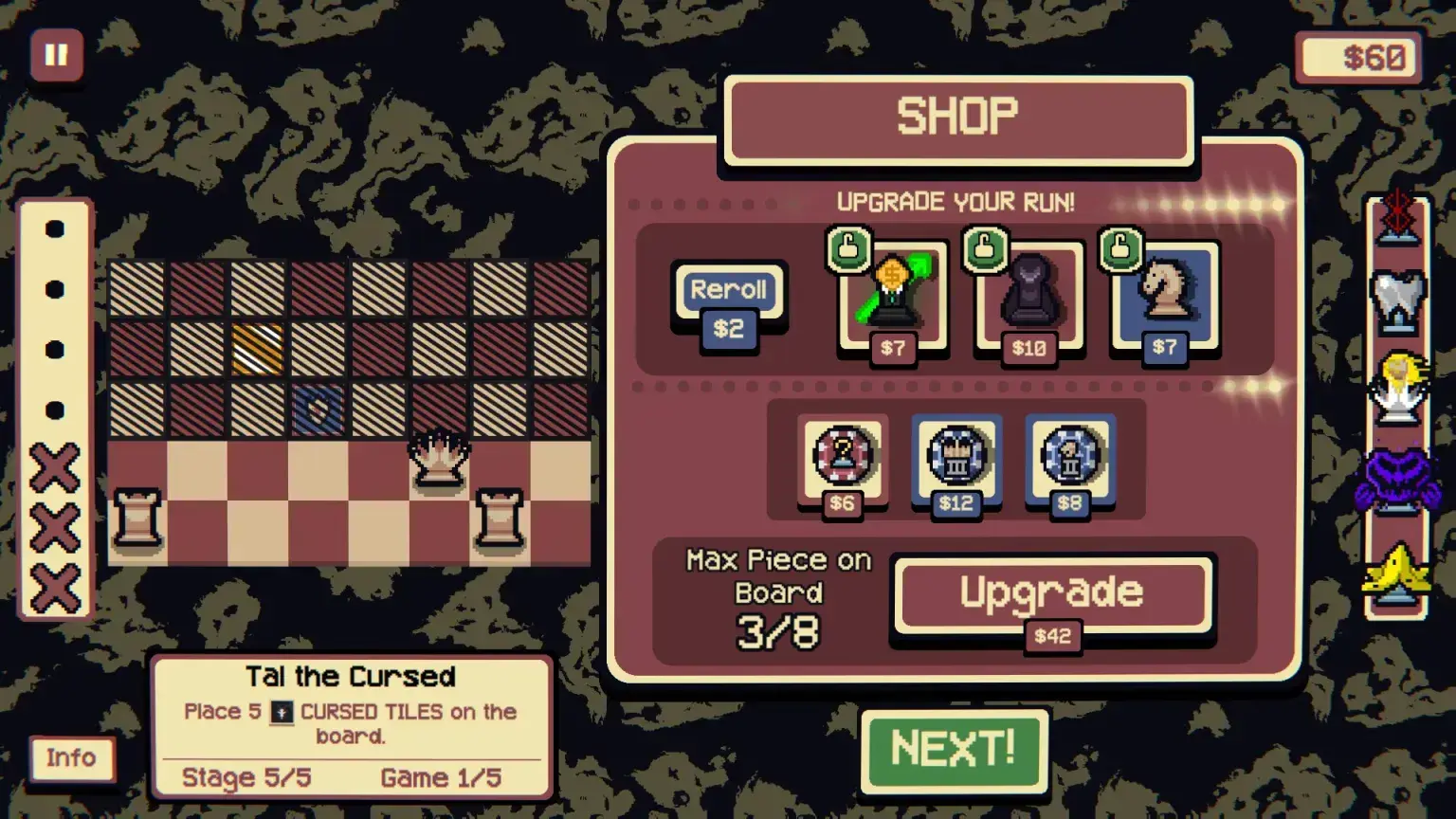
During the initial deployment, you can place three pieces on the board while keeping seven in a “reserve” pool, with the option to increase these numbers as you progress. To accommodate the growing armies, the board also expands by one row during each stage. While this sounds like it would lead to epic confrontations, the scaling often feels mechanical rather than organic, serving only to stretch the playtime.
Variety, or the lack thereof, is perhaps the game’s most immediate hurdle. Each stage seems to rely on a very limited set of piece configurations, meaning you will face the same setups repeatedly. In my early runs, I found myself utilizing strategies that mirrored standard chess openings – a predictable outcome that runs contrary to the spirit of a roguelite, where adaptability should be paramount.
Visually, Gambonanza does have its charms, featuring a clean low-fi aesthetic paired with a calm, stress-free soundtrack. There are small, endearing touches, such as Metal Gear Solid-style exclamation marks appearing over pieces under attack or pieces catching fire after a series of captures. However, these neat animations are somewhat sluggish and quickly lose their novelty. The same applies to the upbeat music; the single track is pleasant at first but becomes grating as it loops endlessly through menus, shops, and combat.
Despite its name, the game does very little with its gambling theme beyond surface-level aesthetics. Your purchases in the shop are determined by visual metaphors like slot machines, pachinko, or capsule toys, but these feel like decorative skins rather than integrated mechanics. It leaves the impression of a shallow attempt to ride the coattails of Balatro’s success rather than a thoughtful marriage of chess and chance.
Yet, these stylistic complaints are minor compared to the game’s functional failures. The core problem is that the experience fundamentally breaks down during play.
Strategic limitations of the AI
The design of Gambonanza raises a troubling question: could this game even function if the AI wasn’t intentionally lobotomized? Any player will realize that an invincible piece immediately destroys the tactical flow of a match. This is exactly what happens in boss fights, where the opponent controls an “elite” piece that cannot be captured until every other enemy unit is cleared from the board. This single modifier outweighs almost any combination of Gambits you can build, making victory feel like it depends more on the AI making a mistake than on your own cleverness.
Defeating these bosses is an unrewarding affair, yielding only a small amount of extra currency rather than unique loot. The fact that bosses are interchangeable across different stages further strips them of their identity. My first run featured a mechanized Magnus Carlsen as the second boss and a masked Botez sister as the final challenge – a nod to the chess world that feels more like an inside joke than a meaningful feature. To make matters worse, you are forced to watch unskippable boss introductions every single time.
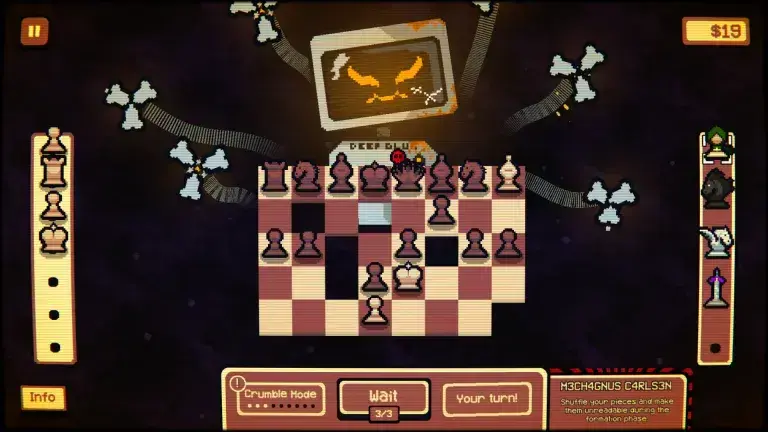
The interchangeability of these bosses also highlights a complete lack of balance. A boss like Kev Borklik, who possesses two additional invulnerable pieces until you pass your turn three times, can appear on the first stage when the AI has too few pieces to use the advantage. Alternatively, he can appear as the final boss on a 10-row board with a full army, where the player is left entirely at the mercy of “artificial stupidity” regardless of their actual strategy.
This leads to the most damning realization of all: even winning a match in Gambonanza fails to provide a sense of satisfaction.
The imbalance of rising difficulty
The difficulty curve in this title is less of a slope and more of a sudden cliff. You move instantly from a state where you have to actively try to lose, to a state where the AI has to actively try to lose for you to have a chance. There is no middle ground where skill and mechanics meet in a satisfying challenge.
In a successful roguelike, the goal is to assemble a collection of items that synergize to “break” the game. However, when the base game is so easily exploited with standard pieces, the pursuit of these synergies feels redundant. Since you always move first and can position pieces for free captures or use Gambits that skip enemy turns, the gameplay quickly shifts from engaging to routine.
Upon completing a run, the game unlocks new “Ascension” style difficulty levels, each adding four negative modifiers alongside a negligible benefit. Initially, these are minor – such as reduced interest or fewer shop items. However, the restrictions soon become stifling, such as removing the ability to purchase queens entirely. By the time you reach “Bishop complexity” – the fourth of six levels – the AI is given the first move.
And that is where the logic of the game collapses.
It isn’t that the game becomes impossible at this stage – though it is significantly harder – but rather that you become entirely dependent on the AI’s semi-random decision-making. At higher difficulties, most of my successful runs felt like the result of the computer making a catastrophic unforced error rather than the culmination of a brilliant strategic plan.
Ultimately, it is nearly impossible to develop a consistent strategy against an invincible enemy piece that can be utilized at any moment. The game stops being about chess and starts being about surviving the AI’s whims.
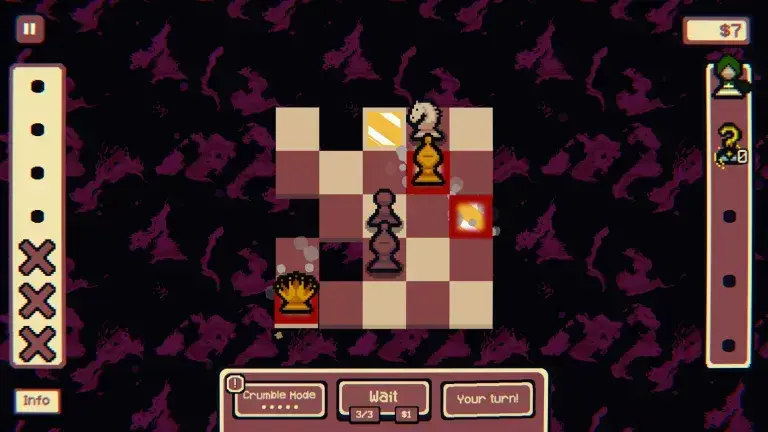
This frustration is compounded by the “Crush” mechanic: if five turns pass without a capture, tiles begin falling off the board, sending any piece standing on them into the abyss. While the game indicates which tiles will fall next, the pattern feels erratic. You cannot plan long-term because you might be forced to choose between losing a piece to an enemy attack or losing it to a tile that was just marked for destruction.
At the “Bishop” difficulty and beyond, this mechanic becomes even more aggressive, removing three tiles per turn instead of two. Regrettably, this is one of the few ways the game actually manages to inject variety into its gameplay, though it does so through frustration rather than innovation.
The early stages remain trivial even on high difficulty, leading to a repetitive slog as you wait to reach the “hard” parts – the flaws of which we have already examined in detail. There is simply not enough diversity in the encounters to justify the time spent reaching the endgame.
Gambonanza is a game defined by surface-level themes and a gameplay loop that is either too simple or entirely reliant on built-in AI incompetence. While there is a fleeting charm to the presentation, it ultimately fails as a chess game, a gambling experience, and a roguelite. In the end, it leaves very little reason to keep playing; sometimes, the only winning move is to walk away from the board.