
Titanium Court stands as a significant and frequently gripping experience because it captures the essence of a very specific kind of devotion. This is not a traditional romance – in fact, keeping track of the narrative and its expanding roster of characters can be quite a challenge during a single sitting. The emotional threads often feel vague at the start, while plot developments – such as the sudden appearance of a football – can seem entirely arbitrary.
Yet, the game itself feels deeply in love. It is enamored with its own creative spark, its imagination, and its sheer structural complexity. There is a palpable energy in how it manifests from one moment to the next. It thrives on the audacity of throwing eggs at the player and claiming they are soccer balls, eventually transforming this chaotic labor into layers of mechanical ingenuity for the player to unravel.
This becomes most evident during the initial hours, where the game seems intentionally obscure. Titanium Court has a habit of interrupting itself, offering caveats or even completely retracting a newly introduced concept with a sudden twist. While one could describe it simply as a brilliant, absurd exploration of the narrative potential within the match-3 genre, the game itself refuses to take the easy path toward simplification.
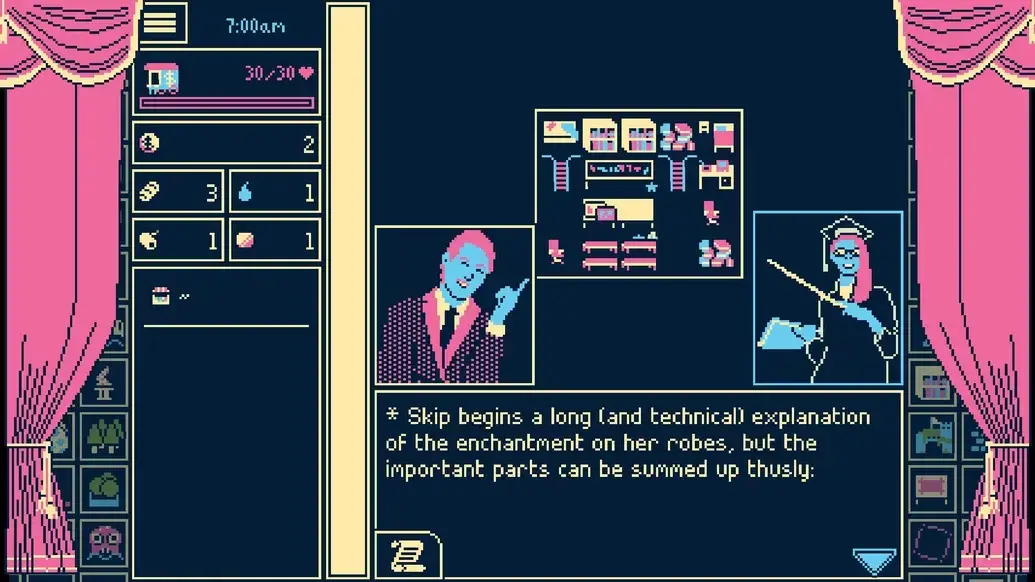
Take a deep breath. Every morning, the player wakes up to explore the gardens and chambers of a bizarre court. Fae creatures appear to be in charge, and the protagonist has seemingly blundered into a position of importance within their realm. While these details were likely explained early on, the sheer volume of information Titanium Court provides on various subjects makes it difficult to retain every single plot point.
Certain patterns, however, remain clear. The day begins with breakfast, followed by world-building through mundane actions:
- Taking a shower, which triggers a match-3 puzzle involving soap and bubbles
- Visiting the library or unlocking a new room
- Engaging in an elliptical conversation with a stranger
- Attending a magic lesson, only to be told you must teach the next one
Discovery is constant, even when you are unsure what it all means.
This abundance of content serves to provide bonuses, upgrades, and world-building flavor, all delivered through sharp, mocking prose and charming miniature characters. Key narrative beats are punctuated by pixel art metaphors – such as a home run or a cat with its prey – while the court members often resemble 1980s magicians, complete with skinny ties and high-cuffed suits. It is an aesthetic that feels uniquely specific.
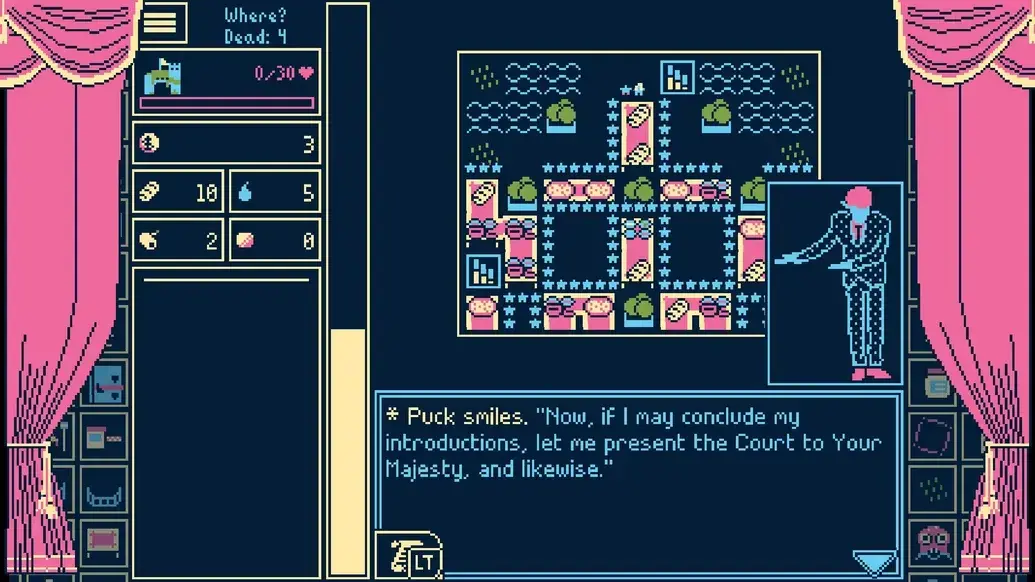
There is a peculiar sense of nostalgia here. The use of randomized art and portraits evokes the visual flourish of Windows Solitaire cards cascading across a screen. The color palette – soft pinks and gentle beiges – mirrors the hues of childhood ice cream, while the battle grids resemble a slice of Battenberg cake. The entire experience feels as charming and perhaps as fleetingly sweet as marzipan.
Combat mechanics and grid strategy
At this juncture, the game transitions from a whimsical visual novel reminiscent of “A Midsummer Night’s Dream” into a rigorous match-3 experience. It is a robust system where classic genre wisdom applies – such as making matches at the bottom of the board to trigger cascades from above. However, the game also grapples with the inherent unfairness of the genre, as players cannot see what tiles are waiting to drop from the top of the screen.
While titles like Gyromancer countered randomness by punishing time-wasting, Titanium Court takes a different approach. It refuses to take its own rules too seriously, burying any concerns regarding fairness under a landslide of eccentricities. The player is constantly distracted by tricks, eggs, footballs, birdcages, and strange jars, which mask the underlying unpredictability of the board.
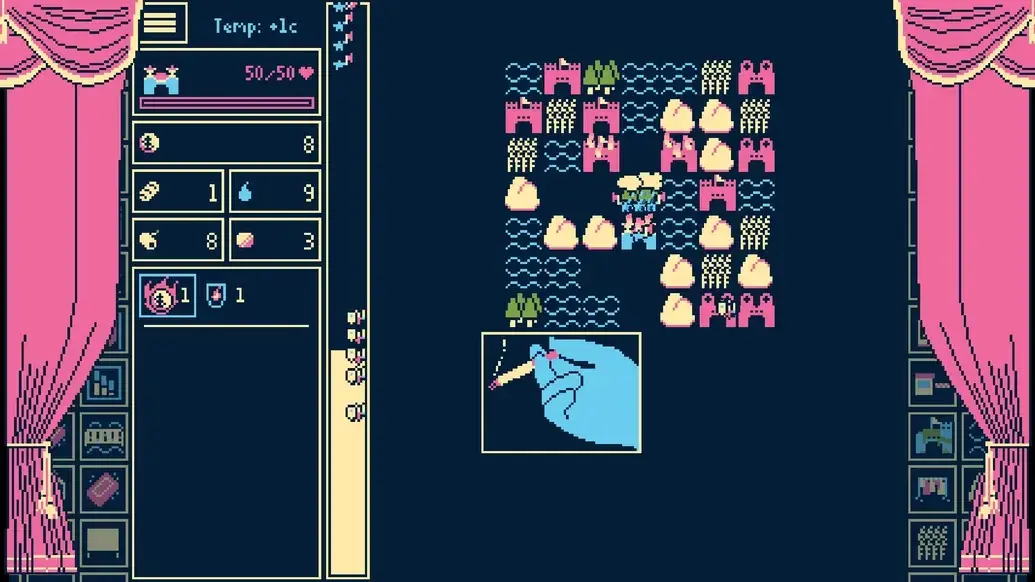
To break it down, the combat cycle is divided into two distinct phases. During “High Tide,” players prepare for conflict by engaging with the match-3 board. The tiles here represent the actual terrain where the battle will occur, serving a dual purpose. They provide the resources necessary for the fight while simultaneously shaping the physical battlefield.
Mountains yield stone and rivers provide water, but they also create tactical obstacles. High peaks hinder troop movement, while water blocks units without access to boats. This creates a strategic tension: should one match water and mountain tiles to secure resources for unit deployment, or prioritize creating a defensive moat and mountain range to protect the court’s most vulnerable sections?
Tactical execution and the flow of battle
The decision-making process creates a constant chain reaction. Players must choose between harvesting food or using limited moves to dismantle enemy fortifications. Capturing every stronghold might make the subsequent fight easier, but it often comes at the cost of vital resources that are needed for the long-term campaign.
Holding specific tiles – such as those containing shops or chests – allows players to access these rewards once the preparation phase concludes. The sheer number of variables in the “High Tide” phase is significant, even in its most basic form. Players are tasked with organizing the field, gathering supplies, securing valuables, and thinning out the enemy ranks simultaneously.
When the “Ebb” phase begins, the match-3 logic gives way to an auto-battler. Units are deployed based on their specific roles:
- Units that prioritize resource collection
- Units that focus on base defense
- Specific professions that allow players to set fire to surrounding tiles
The player watches as their tactical preparations are put to the test.
The opposition evolves rapidly, moving from basic thugs to centaurs, wormholes, catapults, and massive warships. Each enemy type requires a specific tactical response within the game’s decision-making web. After the dust settles, players must evaluate their health, resources, and the next destination on the map to determine which enemy types they are prepared to face next.
While the combat initially seems to be the core of Titanium Court, the true heart of the project lies in the interplay between its many moving parts. The campaign becomes progressively stranger, and while the experience can occasionally feel exhausting, it never descends into mere tedium.
This resilience stems from the evident passion behind the design. There is a specific stage in creative work where, after overcoming the initial hurdles, the process of adding ideas becomes a source of pure joy. It is a moment where a creator might be tempted to keep stacking concepts, one on top of the other, simply because the act of doing so is rewarding.
“Adding on” – as one teacher once called it – is both a delight and a danger.
One might compare this to “adding on” – a process that is both a delight and a danger. Over-stacking ideas can sometimes overwhelm a project, much like ruining the silhouette of a garment by stuffing the pockets with toy cars. However, Titanium Court suggests that there is immense potential in this maximalist approach.
The game continuously integrates new elements – characters, dialogue, lore, and even surreal musical interludes that evoke a handcrafted version of Surf music. It feels as though the developers reached a point of revelation where the horizon became limitless. They realized they could keep adding to this world indefinitely, and that sense of boundless creativity is what ultimately defines the experience.